How Value-Based Bidding Works & When to Use It

Value-based bidding is an automated bid strategy in Google Ads that optimizes campaigns toward revenue and profit rather than conversion volume or clicks. This approach assigns monetary values to different conversion actions, allowing Google's machine learning algorithms to prioritize high-value customers over low-value ones.
I've used value-based bidding to scale lead generation campaigns to hundreds of thousands of dollars per month in ad spend. It's the strategy that separates advertisers optimizing for vanity metrics from those optimizing for actual revenue.
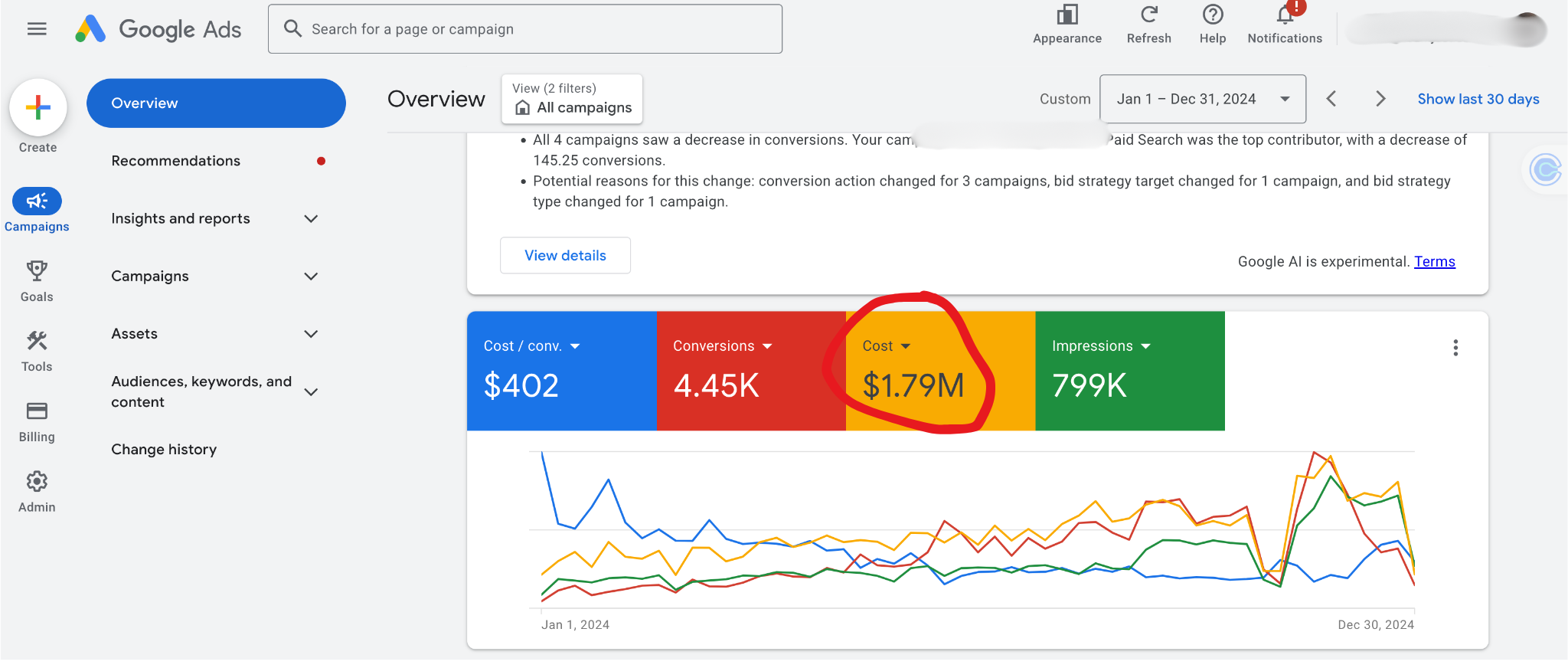
Traditional bidding strategies treat all conversions equally. A $50 purchase counts the same as a $5,000 purchase. Value-based bidding fixes this problem by weighting bids according to predicted conversion value.
What Is Value-Based Bidding in Google Ads?
Value-based bidding is a category of Smart Bidding strategies that use conversion value data to maximize revenue or return on ad spend. Google's algorithms analyze historical conversion data, user signals, and contextual information to predict which clicks will generate the highest value.
The system requires conversion tracking with assigned values. These values can be static, where every purchase has the same assigned value, or dynamic, where actual transaction amounts pass back to Google Ads in real time.
Google processes this data through machine learning models that factor in device type, location, time of day, audience segments, and hundreds of other signals. The algorithm then adjusts bids in real-time auctions to capture users most likely to generate high conversion values.
How Does Value-Based Bidding Work?
The mechanism operates through three stages: data collection, value prediction, and bid optimization.
First, conversion data flows into Google Ads. This includes which users converted, what actions they took, and what value those actions generated. For e-commerce, this typically means order totals. For lead generation, values might represent predicted customer lifetime value or lead quality scores.
Second, Google's machine learning analyzes patterns in this data. The system identifies which user characteristics and behaviors correlate with higher conversion values. A user searching on mobile at 9 PM might historically generate 40% higher order values than desktop users at noon. The algorithm learns these patterns.
Third, bids adjust automatically during each auction. When a high-value user triggers an ad impression, the system bids more aggressively. For lower-value signals, bids decrease. This happens in milliseconds, across millions of auctions daily.
What Are the Best Value-Based Bidding Strategies?
Google Ads offers two primary value-based bidding strategies: Maximize Conversion Value and Maximize Conversion Value with Target ROAS. Each serves different business objectives and requires different levels of historical data.
Maximize Conversion Value
Maximize Conversion Value instructs Google to generate the highest total conversion value within your daily budget. The algorithm spends your full budget while prioritizing high-value conversions over low-value ones.
This strategy suits advertisers focused on revenue growth without strict efficiency requirements. The tradeoff is unpredictability. ROAS fluctuates day to day since the algorithm optimizes for total value, not efficiency.
Google requires at least 15 conversions in the past 30 days, though 50 or more delivers stable performance. Campaigns need sufficient budget headroom since the system bids aggressively when it spots high-value opportunities.
Maximize Conversion Value with Target ROAS
Target ROAS adds an efficiency constraint to value maximization. You specify your desired return on ad spend, and Google optimizes toward that target while maximizing conversion value.
Setting a 400% target ROAS tells Google you want $4 in conversion value for every $1 spent. The algorithm balances volume against efficiency, passing on auctions that don't meet your profitability threshold.
This strategy suits advertisers with defined margin requirements. If your breakeven ROAS is 300%, setting a target above that ensures profitable growth. The system sacrifices some conversion value to maintain your efficiency floor.
Target ROAS needs more historical data than Maximize Conversion Value. Performance improves substantially with 50 or more monthly conversions. Campaigns with fewer conversions often see erratic results as the algorithm lacks sufficient signal.
How Is Value-Based Bidding Different from Other Bidding Strategies?
The fundamental difference lies in optimization objectives. Volume-based strategies like Maximize Conversions treat all conversions equally. Value-based strategies weight conversions by monetary impact.
With Maximize Conversions, Google might generate 100 conversions worth $5,000 total. With Maximize Conversion Value using the same budget, you might get 70 conversions worth $8,000. Fewer conversions, higher revenue.
Manual CPC and Enhanced CPC give advertisers direct bid control but can't process the hundreds of signals that automated strategies leverage in real time. Target CPA focuses on cost efficiency per conversion without considering value differences, leaving money on the table when customer values vary.
Who Should Use Value-Based Bidding?
Value-based bidding benefits advertisers whose conversions have meaningful value differences. If all conversions generate roughly the same revenue, the added complexity provides little advantage over volume-based strategies.
A lot of marketers think that value-based bidding is just for businesses running e-commerce campaigns. I've personally found success with value-based bidding not just for e-commerce but also for lead generation. Specifically, I've found great success running value-based bidding on some of the personal injury law firm Google Ads campaigns I've run. I imported offline conversion data from the law firm's CRM into Google Ads, assigning dynamic values to different cases that were signed.
What Metrics Should You Use to Measure Value?
Conversion value measurement depends on your business model.
Ecommerce businesses typically track transaction revenue through dynamic values pulled from the shopping cart. Each transaction passes its actual order total to Google Ads.
Lead generation requires proxy metrics that correlate with actual customer value. Three approaches exist:
How do you calculate the value of conversions?
Static values assign fixed amounts based on conversion type. A demo request might be worth $500 while a whitepaper download gets $50, reflecting average customer value multiplied by close rates.
Dynamic values use lead scoring or CRM data based on lead characteristics. A Fortune 500 lead receives higher value than a small business inquiry.
Predictive lifetime value models estimate future customer worth based on firmographic data, engagement patterns, and behavioral signals.
The metric you choose shapes algorithm behavior. Revenue optimization maximizes top-line growth. Profit optimization accounts for margin differences. Lifetime value optimization prioritizes long-term customer relationships.
Calculating Qualified Lead Values from Converted Lead Data
Converted leads aren't the only type of lead you can assign a conversion value to. You can also estimate the amount of qualified leads it takes to get one converted lead and do the math to come up with a qualified lead conversion value.
For example, if you talk to your sales team and figure out that it takes eight qualified leads to turn into one converted lead, you can calculate backwards from your converted lead value. In my car accident converted lead example where a signed case is worth $10,000, one qualified lead would equal $1,250. Simply divide the conversion value of one converted lead by the number of qualified leads it takes to get one converted lead.
This approach lets you optimize toward earlier-stage conversions while still weighting them according to their actual downstream value.
How to Set up Conversion Values in Google Ads?
Navigate to Goals, then Conversions in Google Ads. Select your conversion action and choose from three value options:
"Use the same value for each conversion" assigns a static amount. This works when conversion values are uniform or you lack dynamic data.
"Use different values for each conversion" enables dynamic tracking. Pass transaction values through your conversion tag or Google Tag Manager. Shopify and WooCommerce handle this automatically.
"Don't use a value" removes the conversion from value-based optimization. Use for micro-conversions you want to track but not optimize toward.
Assigning Different Values to Different Conversion Actions
For lead generation campaigns specifically, you can assign different conversion values to different conversion actions that you and your sales team know have a better chance of converting. For example, if your team knows that form submissions have a better chance of leading to sales than phone calls do, you can simply assign a higher conversion value to the form submission conversion action.
How Do You Implement Value-Based Bidding?
Implementation requires offline conversion tracking configuration, value assignment, and strategy selection. Before switching strategies, accumulate at least 30 days of conversion history with values attached. Data quality matters as much as quantity. Ensure values reflect actual business outcomes, and validate estimated lead values against closed revenue periodically.
Each conversion must connect back to the specific click that generated it. This click-level data enables the algorithm to learn which characteristics predict high value.
The Bidding Strategy Progression Lifecycle
It's important to understand the progression lifecycle of your campaign's bidding strategies. When you have a new account or a new campaign without any conversion data, I recommend starting the campaign on a manual CPC bidding strategy.
After this manual CPC bidding strategy has accumulated around 30 conversions, you can then switch the bidding strategy to a Max Conversions smart bidding strategy. At this point, you can also begin uploading your offline conversions into Google Ads with assigned conversion values.
After about 30 conversions uploaded with conversion values tied to them, you can then switch your bidding strategy once again to a value-based bidding strategy, such as Max Conversion Value or Target ROAS.
This staged approach gives Google's algorithm the data foundation it needs at each level before asking it to optimize for increasingly sophisticated objectives.
My Lead Gen Implementation Example
This offline conversion import strategy uses converted leads with various conversion values. In my case, signed car accident cases were assigned a value of $10,000. Once you have enough uploaded offline leads with a combination of qualified and converted leads—I would recommend around 30-50 offline leads imported—then you can switch your Google Ads campaign bidding strategy to a value-based bidding strategy. This essentially trains Google Ads' algorithm to go after leads that are most likely going to turn into a converted lead or actual revenue for your business.
Implementing Offline Conversion Tracking in Google Ads
Offline conversion tracking attributes sales happening outside your website back to specific ad clicks. Phone calls that close deals, in-store purchases, and contracts signed by sales teams all fall into this category.
Without offline tracking, Google only sees website activity. Form submissions appear as final conversions. The algorithm optimizes toward these proxy actions without knowing which ones generated revenue.
The mechanism relies on Google Click IDs. Every ad click generates a unique GCLID appended to your URL. Your website captures this identifier and stores it in your CRM. When sales closes that lead, you upload the GCLID with conversion value back to Google Ads.
Offline Conversion Tracking Best Practices
Import daily, not weekly. Fresher data means faster algorithm learning.
Validate GCLID capture. Test that forms and CRM correctly store click IDs. Lost GCLIDs mean lost attribution.
Match your conversion window. Google allows up to 90 days. Set this to reflect your actual sales cycle.
Send real values. Use actual deal amounts when possible. Validate estimates against closed revenue quarterly.
What Is Enhanced Conversions for Leads?
Enhanced Conversions for Leads improves offline conversion matching using first-party customer data. Instead of relying solely on GCLIDs, Google uses hashed email addresses to connect ad clicks to conversions.
GCLIDs get lost when leads switch devices, clear cookies, or convert weeks later. Enhanced conversions recover these lost connections using hashed identifiers submitted at form fill and matched during offline import.
Privacy is built in. SHA-256 hashing converts emails into irreversible strings before transmission. Your actual customer data never reaches Google. Advertisers commonly see 20-30% more conversions attributed after implementation.
Using Value-Based Rules as a Smart Bidding Workaround
A more advanced strategy you can leverage using conversion values is setting up value-based rules. You probably know already that when using a smart bidding strategy, Google Ads will completely ignore your advanced bid adjustments, such as increasing or decreasing the bids for zip codes, devices, demographics, and dayparting.
The workaround if you still want to use bid adjustments on a smart bidding strategy is setting up value-based rules. To set up value-based rules, click on "Goals" and then "Value-Based Rules," and create a new value-based rule.
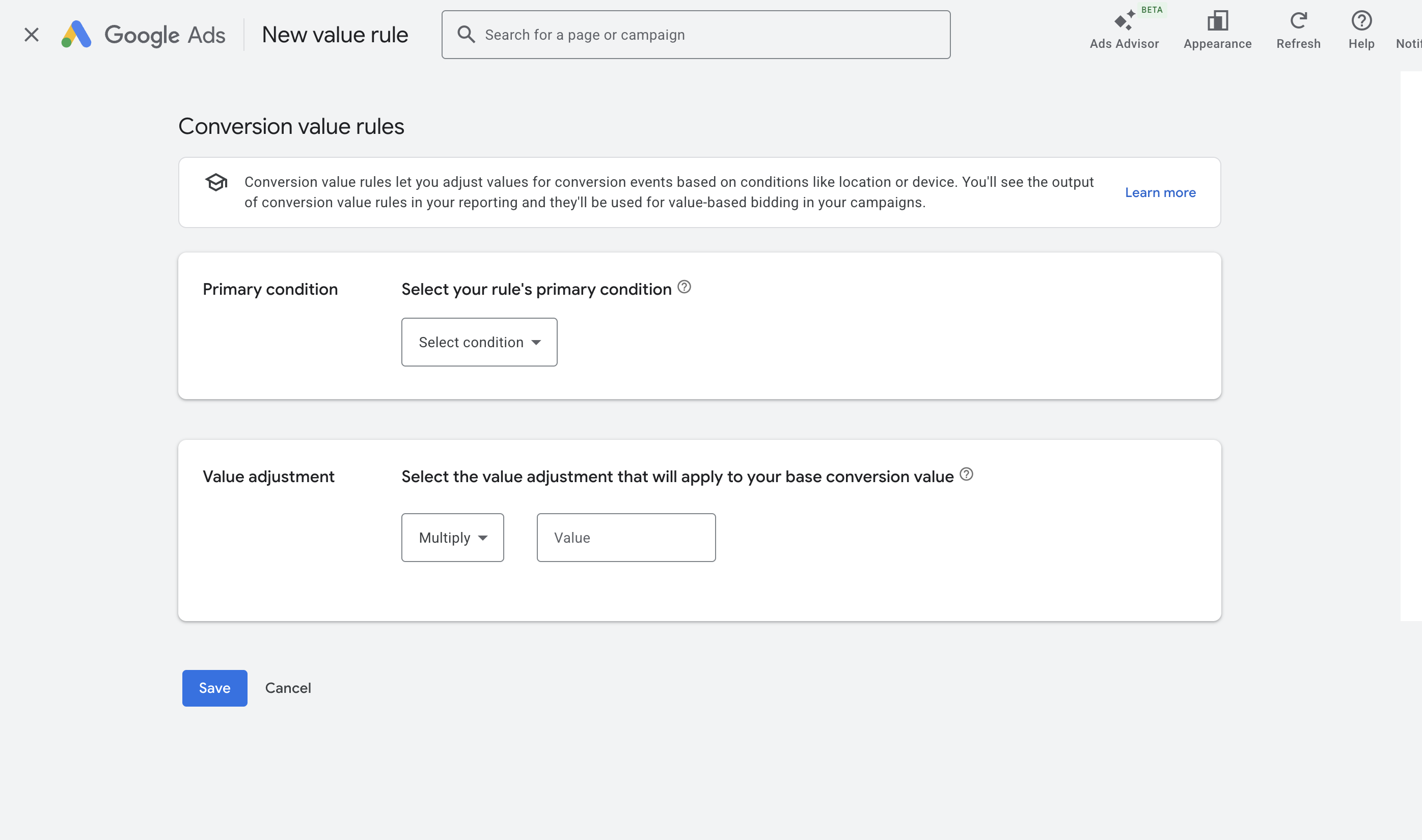
You can set value-based rules for different device types, locations, and audience segments. You can use the multiply or add operator similarly as if you were increasing or decreasing the bids in advanced bid adjustments.
For example, if the conversion value of a simple lead form submission is $100, you can set up a value adjustment for lead forms in a specific audience segment or location by adding or subtracting $10. The new value of a lead form submission in the value adjustment you set up would be either $110 or $90, which is essentially the same thing as increasing or decreasing your bid adjustment by 10%.
What Are Common Value-Based Bidding Mistakes to Avoid?
Poor value data is the most damaging mistake. Assigning arbitrary or inaccurate conversion values trains the algorithm toward wrong objectives. If values don't reflect actual business outcomes, optimization works against you.
Insufficient conversion volume undermines machine learning. Campaigns with fewer than 15 monthly conversions lack data density for reliable pattern recognition. Consider consolidating small campaigns or using portfolio strategies to aggregate data.
Switching strategies too frequently prevents proper learning. Each change resets the optimization process. Commit to a strategy for at least 4-6 weeks before evaluating.
Ignoring conversion lag leads to premature conclusions. Pausing or modifying campaigns based on incomplete data causes oscillating performance. Wait for data to mature before making decisions.
Unrealistic ROAS targets starve campaigns of traffic. If your target exceeds what's achievable, Google reduces bids until impressions drop to near zero. Start with achievable targets based on historical performance, then tighten gradually.
How Can Predictive Analytics Improve Value-Based Bidding?
Standard value-based bidding optimizes toward historical transaction data. Predictive analytics optimizes toward estimated future value before it materializes.
Here's the problem. A $100 buyer who returns six times looks identical to a $100 buyer who disappears forever. Historical optimization treats them the same. Predictive models don't.
Machine learning identifies patterns that forecast customer lifetime value from early signals. First purchase category, acquisition source, and on-site behavior all correlate with future spending. For lead generation, predictive scoring estimates which prospects will close and at what deal sizes based on firmographic and behavioral data.
Implementation requires connecting your CRM or analytics platform to Google Ads. Predicted values flow back as dynamic conversion values or through offline conversion imports.
Tools like Adscriptly streamline this by routing quality signals from your CRM back to Google Ads automatically. Your ads optimize toward closed revenue rather than form fills, without building custom integrations.
